In the world of vibration isolation, keywords like "sound deadening," "damping," and "anti-vibration" are thrown around loosely. Recently, I decided to put a popular set of Amazon rubber washers to the test. They were marketed as high-quality isolators with a "65 durometer" rating.
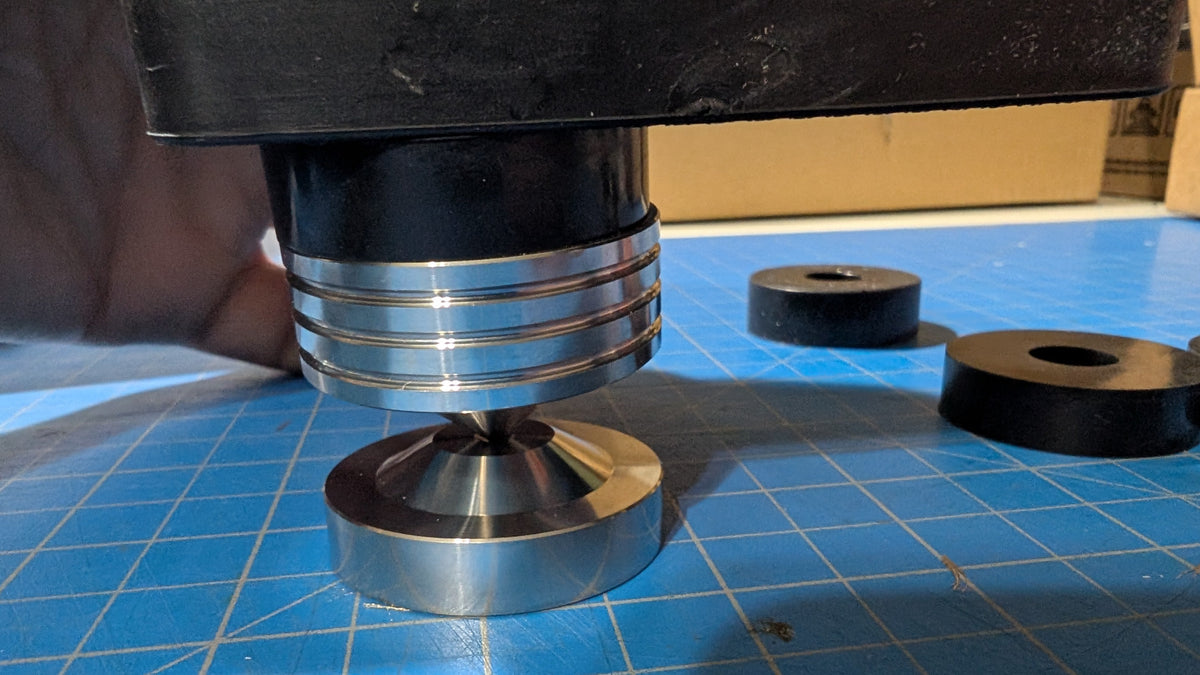
I tested them on two precision pieces of equipment: an Audio Technica turntable and a Yamaha HS8 studio monitor. The results? No noticeable isolation of vibration whatsoever. The rubber was extra firm, lacked any weight load rating, and felt more like a hard plastic than a damping material.
This experience highlights a major problem in the market: the "Shore Scale" trap.
The Science of Shore Scales: A vs. OO
When a product says "65 durometer" without specifying the scale, it is usually hiding the truth about its rigidity. Most cheap industrial rubber is measured on the Shore A scale.
-
Shore A: Measures hard rubbers, like those found in car tires or shoe soles. A "65 Shore A" material is extremely rigid and acts more like a bridge for vibration than a barrier.
-
Shore OO: This is where Sorbothane® lives. The Shore OO scale measures much softer, viscoelastic polymers that can actually deform and absorb energy.
For context, a 30-70 durometer rating on the Shore OO scale is soft enough to "swallow" vibrations. The same number on the Shore A scale is essentially a solid block that will transmit every hum from your motor directly into your stylus.
Why Load Ratings Matter
Engineering is about math, not just materials. The Amazon washers I tested provided no weight load ratings. In vibration science, if a material is too firm for the weight sitting on it, the vibration passes right through it. If it’s too soft, it bottoms out.
Our line of 1.5x0.5" Sorbothane Washers is designed with specific engineering targets:
-
30 Durometer (OO): For lightweight, delicate sensors and small components.
-
50 Durometer (OO): The "sweet spot" for most turntables and studio monitors.
-
70 Durometer (OO): For heavy-duty industrial machinery or large speaker cabinets.

Sorbothane vs. The World
Sorbothane is a unique viscoelastic polymer—it flows like a liquid but maintains the memory of a solid. This allows it to convert kinetic energy (vibration) into negligible heat. Standard rubber is purely elastic; it stores the energy and bounces it back into your equipment.
For over 15 years, we have operated businesses focused on these technical distinctions. We know that while cheap rubber is tempting for the budget, it often costs more in the long run through degraded audio quality or mechanical wear.
The Verdict
If you are trying to protect a $500 turntable or a pair of $700 monitors, don't trust a "mystery rubber" washer from a bulk bin. Look for Shore OO ratings, clear load data, and genuine viscoelastic materials.